
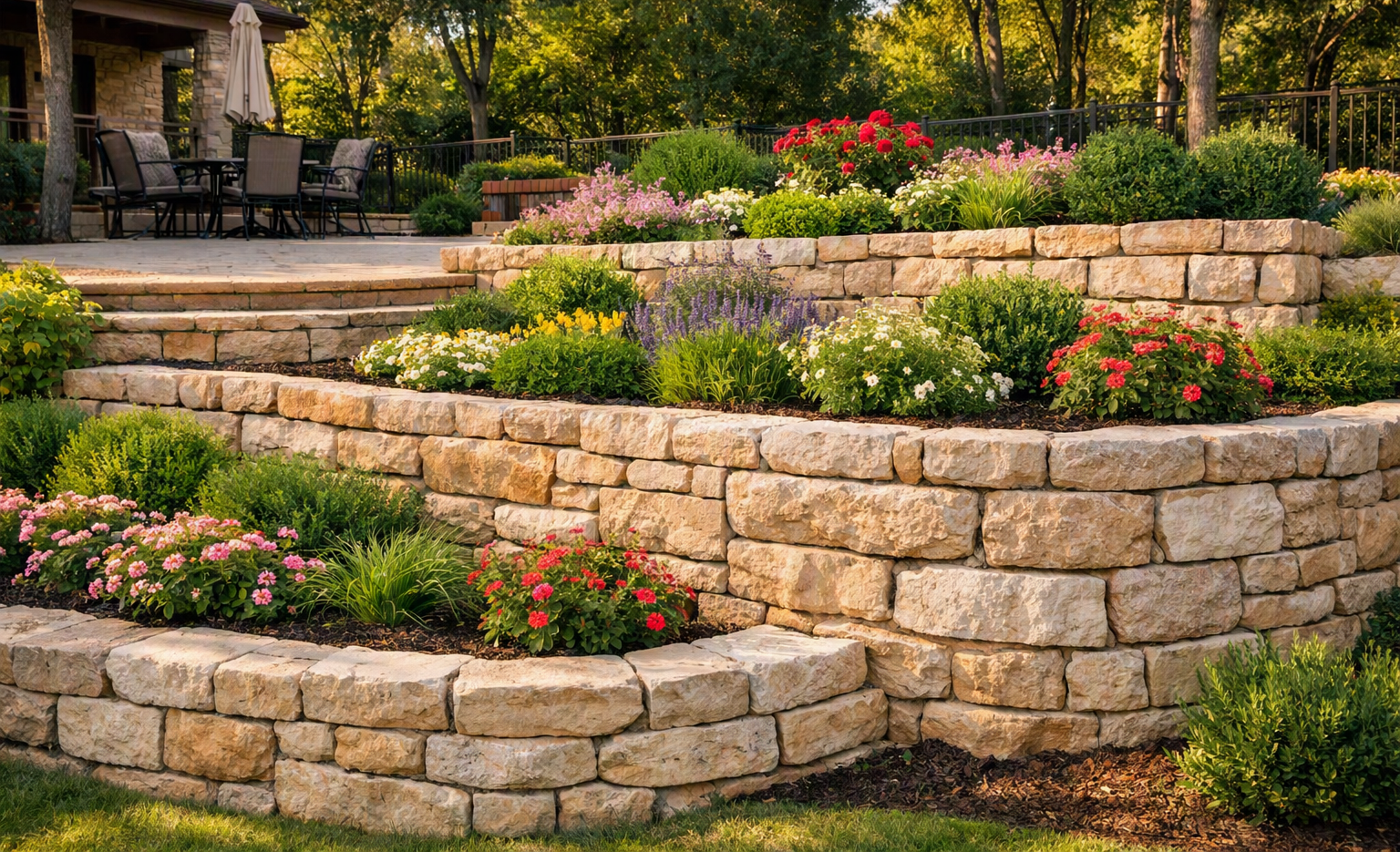
If you have been getting quotes for a retaining wall and you keep seeing a wide range of prices depending on the material, you are not imagining it. The difference between a concrete block wall and a natural stone wall on the same project can be $8,000 to $15,000 or more on a typical residential job. That gap deserves a real explanation because for a lot of Flower Mound homeowners it is worth every dollar, and for others it is not the right call at all.
This post focuses specifically on natural stone retaining walls. What they cost, why they cost that much, what types of stone work best in the DFW climate, and what makes the difference between a wall that looks incredible for 30 years and one that starts to show problems within five.
What Natural Stone Retaining Walls Cost in DFW
Natural stone retaining walls in the Dallas-Fort Worth area run between $38 and $95 per square foot of wall face in 2026, depending on the type of stone, the height of the wall, and whether it is dry-stacked or mortared. That is the all-in number including materials, labor, base preparation, and drainage.
To put that in real-world terms, a 40-foot wall that stands four and a half feet tall, which is 180 square feet of face area, runs from $6,840 at the lower end with boulder or fieldstone up to $17,000 or more for hand-laid premium limestone with a mortar finish. The average natural stone retaining wall project in the Southlake and Flower Mound area comes in around $15,800.
Natural stone is the most popular material choice for retaining walls among DFW homeowners who are focused on aesthetics and long-term property value. Natural stone accounts for 43 percent of retaining wall projects in DFW, which tells you something about how strongly local homeowners feel about the look and longevity of the material relative to alternatives.
Types of Stone Used in DFW Retaining Walls
Not all natural stone is the same and the type you choose affects both the price and the finished look significantly.
Texas limestone is the most common choice in the Flower Mound area and for good reason. It is locally sourced, which keeps material costs lower than imported stone, it has a warm buff and tan color palette that complements the brick and stone homes common in DFW subdivisions, and it weathers beautifully over time rather than looking tired. Chopped or cut limestone gives a more refined, stacked appearance. Rougher quarry-finished limestone gives a more natural, organic look. Both perform well in North Texas conditions. Chopped and weathered limestone walls run $50 to $75 per square foot installed in DFW.
Fieldstone and river rock are the most natural-looking options and work well for walls where you want the structure to feel like it has always been part of the landscape. They are less uniform than cut limestone, which means installation takes more time and skill because each stone has to be individually fitted. Fieldstone walls typically run $22 to $40 per square foot depending on the stone source and complexity.
Boulders are used for larger, more dramatic walls and for naturalistic landscape features where a grand scale is appropriate. Boulder walls run $22 to $38 per square foot but are best suited to properties with the scale to carry them. In a typical suburban backyard they can feel out of proportion. On a larger lot with significant grade changes they can look stunning.
Premium natural stone including granite, sandstone, and imported flagstone runs toward the top of the range and beyond, and is generally reserved for high-end projects where budget is less of a constraint. For most Flower Mound and Southlake homeowners, Texas limestone delivers a premium result at a price point that makes sense.
Dry-Stacked vs. Mortared: What the Difference Means
This is a question that comes up on almost every natural stone wall project and the answer is not as simple as one being better than the other.
Dry-stacked walls are built without mortar, relying on gravity, weight, and careful stone placement to hold the structure together. When done correctly by an experienced mason, a dry-stacked wall is beautiful, flexible enough to handle minor soil movement without cracking, and self-draining because water passes through the gaps between stones rather than building up behind the wall. The challenge is that dry-stacking requires genuine skill. A dry-stacked wall built by someone who does not understand proper base construction, batter angle, and stone selection is going to fail. When it fails it does not crack, it falls over.
Mortared walls are built with mortar between the joints, creating a rigid, monolithic structure. They look more finished and refined than dry-stacked walls and they keep the face of the wall cleaner since there are no gaps for weeds and debris to settle into. The trade-off is that a mortared wall must have proper drainage behind it or the hydrostatic pressure from water buildup will eventually cause it to bow and crack. In North Texas with expansive clay soil, drainage behind a mortared wall is not optional. It is mandatory. A four-inch perforated drainage pipe in gravel backfill is the standard and any contractor who does not include this in their scope for a mortared wall is cutting a corner that will cost you later.
Why North Texas Clay Soil Changes Everything
DFW sits on some of the most active expansive clay soil in the country. The Blackland Prairie clay that underlies most of Denton County expands when wet and contracts when dry, with documented seasonal movement of one to four inches in uncontrolled conditions. That soil movement is the primary enemy of any retaining wall in the area and it is why installation quality matters so much more here than in other parts of the country where the soil is more stable.
A natural stone retaining wall built on a proper compacted gravel base with adequate drainage behind it will handle North Texas soil movement well because there is enough flexibility in the system to accommodate minor shifts without catastrophic failure. A wall built directly on native clay without drainage will eventually move with the soil, and when stone walls move they do not bend, they crack and bulge.
This is also why wall height triggers engineering requirements in most DFW municipalities. Any wall over four feet typically requires a structural engineering review and a building permit. In Flower Mound the permit range is $50 to $450 depending on project scope. This adds to the upfront cost but also means the wall is engineered to perform correctly for your specific site conditions, which is worth considerably more than the permit fee in avoided repair costs down the road.
What Natural Stone Does for Your Property Value
A well-built natural stone retaining wall does more than hold back soil. In DFW neighborhoods where homes are priced in the $500,000 to $1,000,000 range, a natural stone wall signals quality throughout the outdoor space. Buyers notice it immediately and appraisers give it credit. The return on a professionally installed natural stone retaining wall in Flower Mound is generally estimated at 50 to 80 percent of the installation cost at resale, and in higher-end neighborhoods the return is at the upper end of that range.
Beyond resale, a stone wall creates functional flat space that was previously unusable sloped terrain, which is one of the most impactful things you can do to a lot with grade changes. Combined with a paver patio on the newly leveled ground, a pergola for shade, and landscape lighting in the surrounding beds, a retaining wall becomes the foundation of a complete outdoor living space rather than just a structural necessity.
How to Evaluate a Natural Stone Wall Quote
When you are comparing quotes for a natural stone retaining wall, a few questions will tell you quickly whether you are looking at a quality installation or a corner-cutting one.
Ask what is in the base. A proper base for a natural stone retaining wall in DFW includes excavation to undisturbed soil, at least six inches of compacted gravel, and a level footer course before the first visible stone goes down. If a contractor cannot describe this in detail, that is a red flag.
Ask about drainage. For any mortared wall and for dry-stacked walls over three feet tall, drainage behind the wall is essential in North Texas. A perforated pipe in gravel backfill wrapped in filter fabric is the standard. Ask if it is included in the scope and what the drainage outlet point is.
Ask about permits. For walls over four feet, a permit is required in most Flower Mound jurisdictions. A contractor who says permits are unnecessary for a taller wall either does not know the local code or is trying to avoid the engineering review that would require them to build it correctly.
EcoFlow builds natural stone retaining walls across Flower Mound, Southlake, Keller, Lewisville, Trophy Club, Argyle, Colleyville, and the surrounding DFW area. We handle proper base preparation, drainage, and the full permit process when required so the wall performs the way it should for the long term. Call us at (469) 224-8300