
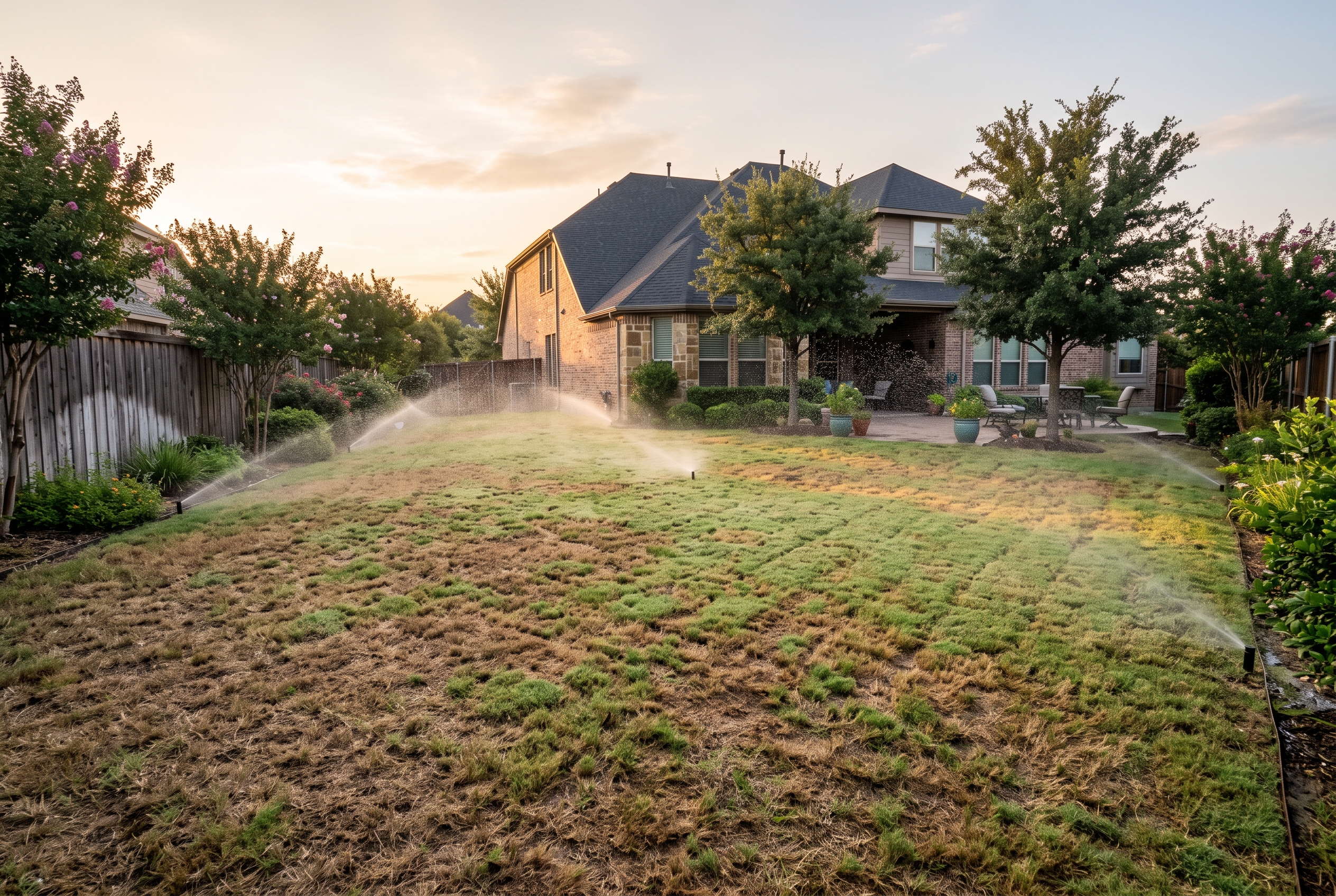
August is the hardest month of the year for a North Texas lawn. If yours is looking rough right now, patchy, yellowed, thin in spots, or just not bouncing back the way it should after you water it, you are not alone and you are not necessarily doing anything wrong. The combination of extreme heat, clay soil, and the occasional stretch of no rain that DFW delivers every August puts even well-maintained lawns under serious stress.
The good news is that there are specific things you can do right now, in August, to protect what you have and set your lawn up to come roaring back when the temperatures drop in September and October. And there are also a few things that people commonly do in August that actually make things worse. This post covers both.
Understand What Your Grass Is Doing
Most lawns in Flower Mound, Lewisville, Keller, and the surrounding DFW area are either Bermuda grass or St. Augustine. Understanding which one you have changes how you should be managing it right now.
Bermuda grass is one of the most heat-tolerant turf options available and handles a DFW summer better than almost anything else. When it goes brown in August, it is often going dormant rather than dying. Dormant Bermuda will come back on its own when temperatures drop and rain returns. You do not need to panic about brown Bermuda in August. You do need to make sure you are not overwatering it into a soggy, disease-prone state trying to keep it green when it just wants to rest.
St. Augustine is a different situation. It does not go dormant the same way Bermuda does. When St. Augustine struggles in August it is actually struggling, and if the stress is compounded by poor drainage, compacted soil, or chinch bug damage it can thin out significantly and leave bare patches that need real work to recover. If your lawn is St. Augustine and the damage is patchy rather than uniform, look closely at the affected areas. Chinch bugs are a common culprit in DFW St. Augustine lawns during hot, dry spells and they require treatment, not just water.
Water Smarter, Not More
The single biggest lawn care mistake DFW homeowners make in August is watering at the wrong time and in the wrong amounts. Watering in the middle of the day means most of the moisture evaporates before it ever reaches the root zone. Watering too lightly encourages shallow root growth which makes the grass significantly more vulnerable to heat and drought stress.
The right approach is deep, infrequent watering scheduled in the early morning, ideally between 4am and 8am. Deep watering means letting the system run long enough for water to penetrate six to eight inches into the soil, not just wetting the surface. This encourages roots to grow downward in search of moisture rather than staying shallow where they are most vulnerable.
If you have an irrigation system and it is running daily for short cycles, change that programming today. A properly designed irrigation system running on an efficient schedule is the single most impactful thing you can have for a DFW lawn in August. If your system needs repairs, new zones, or a programming check, late summer is actually a good time to address it before the fall growing season kicks in. Our team handles irrigation repairs and new zone installations across Flower Mound and the DFW area.
Raise Your Mower Deck
A lot of homeowners think cutting the grass shorter means less frequent mowing. What it actually does in summer is remove the leaf blade that shades the soil, which drives up soil temperature and puts the root system under even more stress during the hottest part of the year.
In August, raise your mower deck. St. Augustine should be kept at around three and a half inches. Bermuda at one and a half to two inches depending on the variety. Taller grass shades its own root zone, retains soil moisture better, and is simply more resilient during a heat event. This is one of the easiest and most impactful adjustments you can make right now at zero cost.
Hold Off on Fertilizer
August is not the time to push your lawn with heavy nitrogen fertilizer. Nitrogen drives new growth and new growth during peak summer heat puts enormous stress on a plant that is already working hard just to survive. Heavy fertilization in August can scorch the lawn and make patchy areas significantly worse.
If you want to fertilize, wait until early September when temperatures start to come down and the grass is coming out of its stress period and ready to take up nutrients again. A well-timed fall fertilizer application is one of the best things you can do for a DFW lawn and sets it up beautifully for a strong spring. EcoFlow offers fertilizer applications and weed control treatments timed appropriately for the North Texas calendar.
Watch for Weeds Taking Advantage
Weeds are opportunists. When your lawn is thin and stressed in August, weeds move into the bare spots fast. Crabgrass in particular is a warm-season annual that thrives in exactly the conditions a DFW August creates. If you are seeing weeds filling in where your grass has thinned out, that is a sign the lawn needs some recovery work this fall.
The right move is not to spray aggressively in August when the lawn is already stressed. Targeted spot treatments on specific problem areas are fine but a broad herbicide application on a heat-stressed lawn can do more damage than the weeds themselves. The broader weed control program belongs in the fall and early spring when the lawn is strong enough to handle it and you can address the underlying causes of the thinning at the same time.
Plan Your Fall Recovery Now
The yards that look the best in DFW neighborhoods by October are the ones whose owners started planning in August. If your lawn has significant bare patches, it can be overseed in September for Bermuda or sodded with St. Augustine in early fall for a full recovery before the growing season ends. If your soil is compacted, late summer is a good time to aerate before the fall growing push.
Fall is genuinely the best time to do transformative work on a DFW lawn. The temperatures are more manageable for installation, the grass has the entire fall growing window to establish before winter, and you end up with a yard that looks great by spring instead of waiting through another full summer.
If your lawn took a beating this August and you want a real plan to bring it back, EcoFlow can help. We offer sod installation, fertilizer and weed control programs, and seasonal cleanups across Flower Mound, Southlake, Keller, Lewisville, Highland Village, Trophy Club, Argyle, and the surrounding DFW area.
Call us at (469) 224-8300, email info@ecoflowlandscape.com, or fill out our free estimate form and we will come take a look at what your yard actually needs heading into fall.