
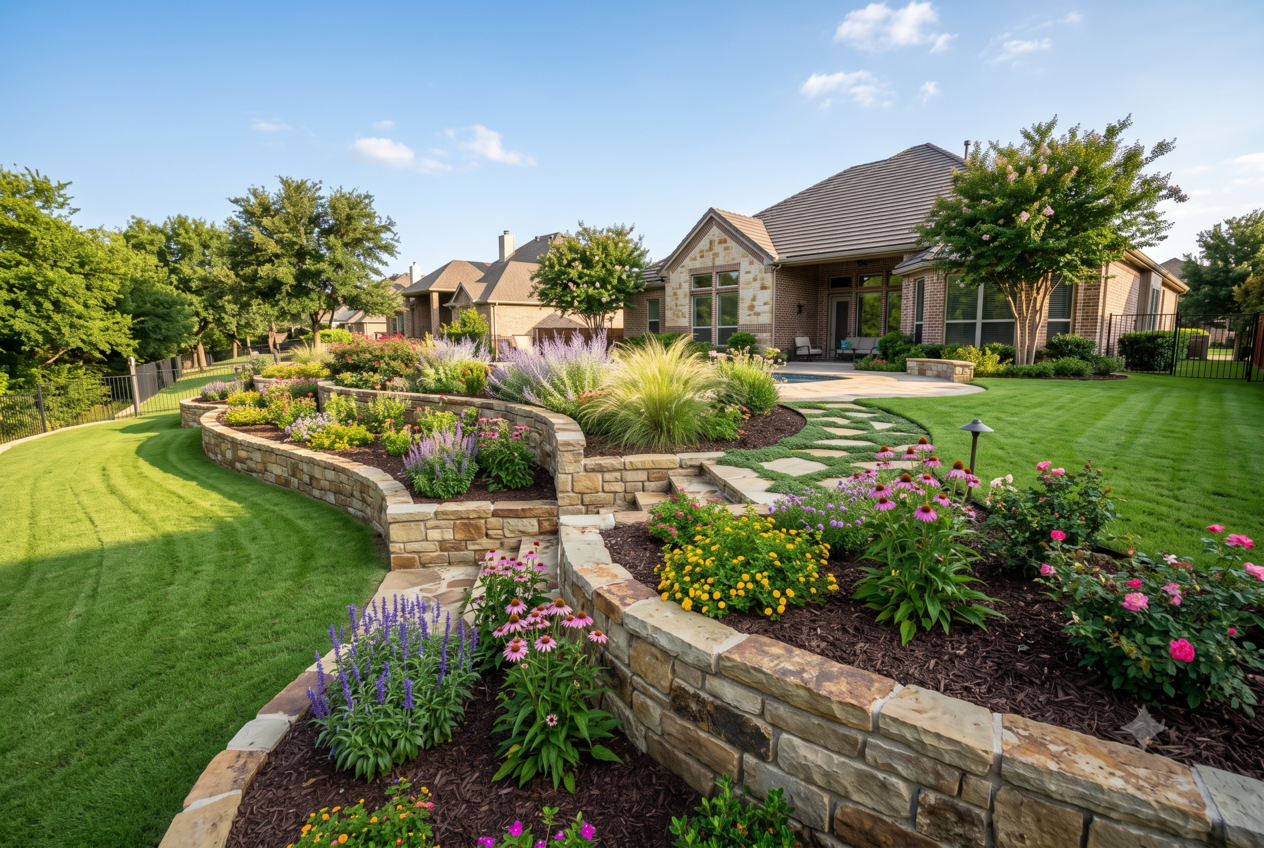
If you have a sloped yard in North Texas, there is a good chance a retaining wall has crossed your mind at some point. Maybe you have erosion starting along the back fence line after heavy rain. Maybe your yard drops off sharply and you want to create a level outdoor space. Maybe your neighbor just had one built and it completely transformed how their yard looks and functions. Whatever brought you here, this post is going to give you straight answers on what retaining walls actually cost in Flower Mound and the surrounding DFW area, what drives that cost up or down, and what you need to know before you hire anyone to build one.
Why Retaining Walls Come Up So Often in DFW
North Texas soil is some of the most challenging in the country to build on. Dallas sits on black expansive clay that expands and contracts dramatically with moisture changes, with seasonal soil movement of one to four inches documented in neighborhoods without proper drainage and subgrade preparation. That movement puts serious stress on slopes, beds, and any structure sitting on or near grade. Add in the heavy spring rain cycles that DFW gets and you have a combination that causes erosion, slope failure, and foundation stress faster than most homeowners expect.
The DFW area has also seen explosive residential growth, with new subdivisions frequently built on lots that required significant grading during development. That grading creates artificial slopes that are not always stable long-term, particularly as vegetation establishes and soil settles. If your home was built in the last ten to fifteen years, there is a real possibility that the graded slope in your backyard is starting to need some structural attention. A properly built retaining wall solves that problem permanently.
What Does a Retaining Wall Actually Cost in Flower Mound?
This is where it gets real. The average retaining wall project in Flower Mound runs around $13,200 based on real local estimates, though costs vary significantly based on material, height, and site conditions.
Here is how the numbers break down by material:
Concrete block walls, which are the most common and most affordable option, run from $25 to $50 per linear foot in North Texas. For a typical 40 to 60 foot wall in a residential backyard that is a project in the $3,000 to $8,000 range depending on height and drainage requirements.
Natural stone walls are the premium option and the one most homeowners in Flower Mound, Southlake, and Trophy Club tend to choose because they look genuinely beautiful and add real curb appeal. Natural stone runs around $38 per square foot of face area, and in Southlake the average natural stone retaining wall project comes in around $15,800. The higher cost reflects both the material and the skill required to lay it properly.
Labor for a retaining wall runs approximately $55 to $85 per hour or $20 to $55 per square foot depending on the material and complexity of the project. Interlocking concrete blocks go in faster than hand-stacked natural stone, which is why the labor cost varies so much between material types.
The Height Rule You Need to Know
This is something a lot of homeowners find out too late. If your wall is more than four feet tall, you will need a structural engineer to design it, and most jurisdictions require a permit for walls taller than three to four feet. Building permits run between $50 and $450 depending on your municipality. In practical terms this means that a taller wall on a steeply sloped lot adds engineering fees and permit costs on top of the construction price. That is not a reason to avoid taller walls if that is what your yard needs, but it is something to budget for upfront rather than discover mid-project.
Drainage Is Not Optional and Here Is Why
This is the single most important thing in this entire post so pay attention to it. Every retaining wall in Dallas and the surrounding DFW area needs drainage. Dallas County sits on expansive clay soil that holds water and creates hydrostatic pressure behind walls. A four inch perforated pipe wrapped in filter fabric, set in twelve inches of gravel backfill, is the DFW standard. Skipping drainage is the number one cause of retaining wall failure in the area and is not covered by most contractor warranties.
What that means in plain English is this. A wall without proper drainage behind it is going to fail. The water that saturates the soil after a North Texas spring rain has nowhere to go, it builds up pressure behind the wall, and eventually the wall buckles or leans. We see this constantly with walls built by contractors who either did not know better or cut corners to win the low bid. The repair cost almost always exceeds what proper drainage would have added to the original project.
At EcoFlow every retaining wall we build includes proper drainage as a standard part of the installation, not an add-on. You can see how we integrate drainage into our hardscaping and drainage services and view completed wall projects in our project gallery.
What Drives the Cost Up
A few things will push a retaining wall project toward the higher end of the range. Significant slope or grade change on the site requires more excavation and a more robust engineering approach. Difficult access, like a backyard that can only be reached through a side gate, slows the work and adds labor time. Curved walls take more skill and more time than straight runs. Removing an existing failed wall adds demolition and disposal cost. And as mentioned above, walls over four feet require engineering review which adds to the project cost but also ensures the wall is built to last.
Waterproofing adds $2 to $10 per square foot and can significantly extend the lifespan of a retaining wall by preventing water from seeping into wall joints and damaging structural integrity over time. For a natural stone or mortared wall in a high-exposure area, it is worth the investment.
What a Retaining Wall Does for Your Property Value
Beyond solving the immediate slope or erosion problem, a well-built retaining wall creates usable flat space that your yard may not have had before. That translates directly into property value. You can expect a return on investment of around 50 to 75 percent on a professionally installed retaining wall in the Dallas area, particularly if it solves a specific drainage or foundation issue. In neighborhoods with significant elevation changes or clay soil challenges, a good retaining wall can be a major selling point that reassures buyers about the property’s long-term stability.
In neighborhoods like Bridlewood, Canyon Falls, and Lakewood Village here in Flower Mound where lot grades vary significantly, a retaining wall that creates a level patio area or stabilizes a sloped backyard is one of the most practical investments you can make. Combined with a paver patio on the newly leveled ground, the transformation is significant.
What to Watch Out For When Getting Quotes
If you get three quotes and one comes in significantly below the others, that gap is almost always telling you something. The most common corners that get cut on low-bid retaining walls are inadequate drainage, using thinner or lower-quality block, skipping the geotextile fabric that prevents soil from migrating through the wall, and not setting footings deep enough for the clay soil conditions in North Texas. A wall that is built correctly the first time will stand for twenty years or more. One that cuts corners on drainage or foundation depth will show problems within two to three years and is expensive to repair because you often have to demolish and rebuild from scratch.
Ask any contractor you are considering how they handle drainage behind the wall. If they do not have a clear, specific answer, that is a signal.
Ready to Get a Straight Quote?
EcoFlow builds retaining walls across Flower Mound, Southlake, Keller, Lewisville, Trophy Club, Argyle, Colleyville, and the surrounding DFW area. We build with natural stone, concrete block, and mortared stone depending on what your yard needs and what fits your budget, and we handle the drainage properly every single time.
If your yard has a slope that needs attention or you want to create level usable space where you do not have it now, give us a call at (469) 224-8300, email info@ecoflowlandscape.com, or fill out our free estimate request form and we will come walk the property with you at no charge.