
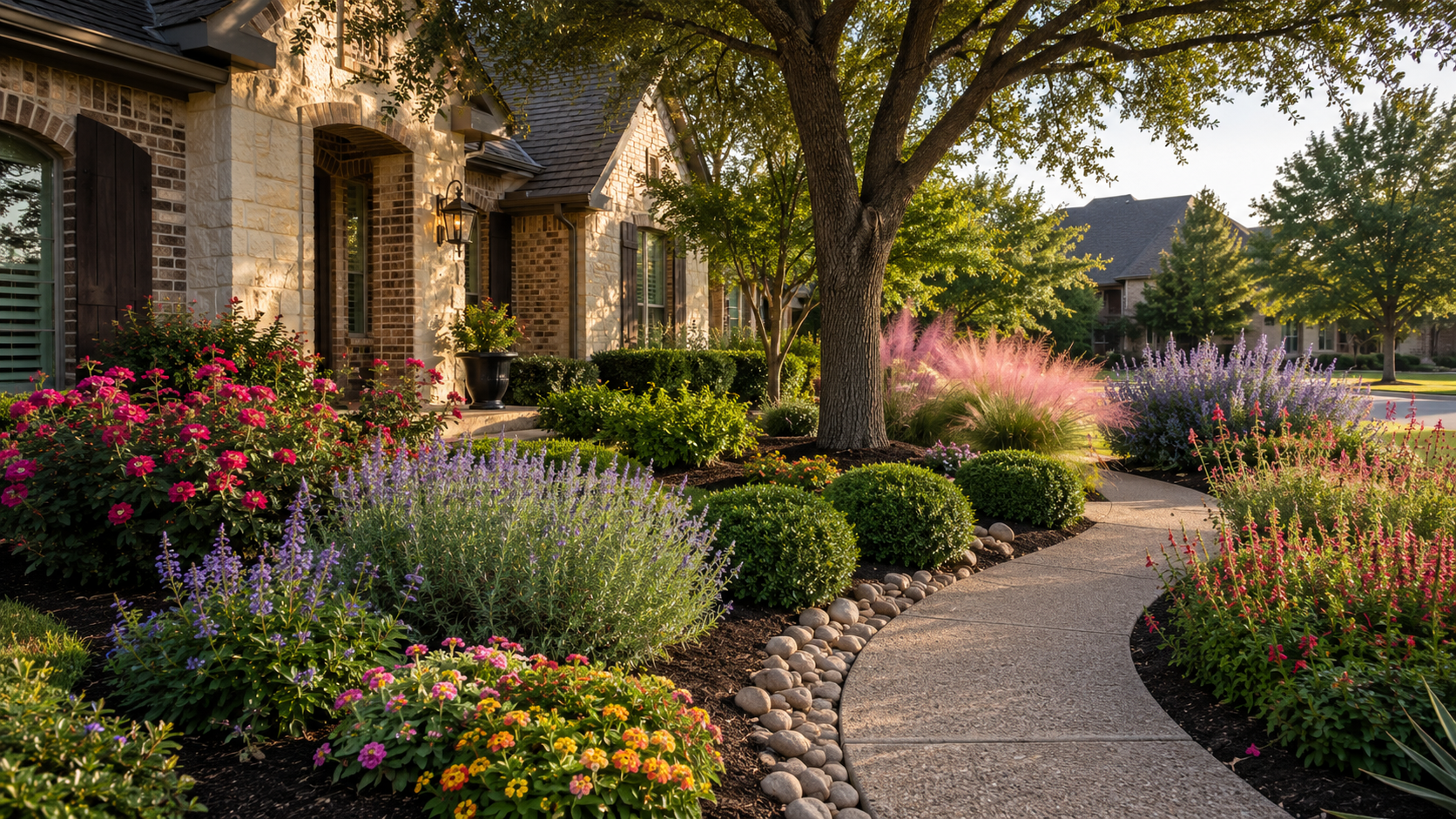
If you have ever put real money into a beautiful landscape only to watch it struggle through a Texas summer, you are not alone. It happens all the time in North Texas, and most of the time it comes down to the same root cause. The wrong plants in the wrong place.
North Texas has a climate that does not forgive poor plant selection. You are dealing with alkaline clay soil, summer temperatures that regularly push past 105 degrees, drought cycles that can last months, and then out of nowhere an ice storm that catches everything off guard. The plants that look beautiful at the nursery in April are not always the plants that are going to look good in your yard in August, or survive February.
The good news is that there is a category of plants that is genuinely built for this. Native and adaptive plants that have evolved to handle what North Texas throws at them, and when you combine the right plant selection with proper installation, good mulching, and a smart irrigation system, you end up with a yard that looks great almost year-round with a fraction of the water and maintenance that a traditional landscape requires.
Here is what actually works in DFW.
Texas Sage
Texas sage, also called cenizo, is one of the most reliable shrubs you can put in a North Texas landscape. It is drought-tolerant, deer-resistant, requires almost no supplemental watering once established, and produces striking purple blooms after rain events. It handles full sun without complaint and does well in the alkaline soils that are common across Flower Mound, Keller, and Southlake. It works beautifully as a hedge, a foundation planting, or a specimen shrub in a landscape bed.
Lantana
Lantana is one of the hardest-working plants in a Texas landscape. It blooms from spring through the first frost in colors ranging from yellow and orange to pink and red, it attracts butterflies and pollinators, and it laughs at heat. Established lantana needs almost no supplemental water during summer and comes back reliably year after year in DFW. It spreads well as a ground cover or spills nicely over the edges of retaining walls and raised beds.
Knockout Roses
Knockout roses changed the game for North Texas gardeners when they were introduced because they did what traditional roses rarely do here — they thrived without a lot of fuss. They are disease-resistant, they bloom repeatedly from spring through fall, they handle the heat, and they do not require the intensive pruning and spraying that old-school roses demand. They come in red, pink, yellow, and white, and they work in almost any landscape bed design.
Muhly Grass
If you want texture, movement, and fall color in a North Texas yard, muhly grass delivers all three. It stays relatively compact and tidy through spring and summer, and then in September and October it erupts into feathery pink and purple plumes that are genuinely stunning. It requires almost no water once established, no fertilizer, and the only maintenance it needs is cutting it back in late winter before new growth starts. It looks exceptional planted in groupings along walkways, near fencing, or at the edges of patio areas.
Salvia Greggii (Autumn Sage)
Autumn sage is a compact perennial that blooms in red, pink, coral, and white from spring through fall. It is a pollinator magnet, extremely drought-tolerant once established, and one of the few plants that blooms reliably in both spring and fall in North Texas without much intervention. It pairs well with lantana and muhly grass and fills in landscape beds with continuous color for most of the year.
Live Oak
If you are adding trees to your property, live oak is the gold standard for North Texas. It is the most climate-adapted shade tree available in this region, handles both drought and clay soil better than almost any other species, and provides canopy coverage that will last for generations. Strategically placed live oaks reduce energy costs by shading the west and southwest sides of a home during summer, which is exactly what you want in a DFW summer. Our tree services include proper placement and planting to give your new trees the best possible start.
Yaupon Holly
Yaupon holly is one of the most underused plants in North Texas landscaping given how well it performs here. It is native to Texas, evergreen, tolerates both wet and dry conditions, and produces bright red berries in winter that bring birds to your yard. It can be maintained as a formal hedge or left to grow more naturally as a screening plant. It is one of the few plants that handles the range of conditions in North Texas, from drought to standing water, without missing a beat.
Decorative Rock and Mulch Matter as Much as Plant Selection
Choosing the right plants is only half the equation. How you finish the beds around them determines how much water they need and how well they survive the summer. A three-inch layer of quality mulch around the base of every plant keeps soil temperatures lower, retains moisture, suppresses weeds, and makes a significant difference in plant survival during a DFW heat wave. Decorative rock and gravel are excellent alternatives in full-sun areas where organic mulch breaks down quickly. EcoFlow installs both mulch and decorative rock as part of full landscape bed installations and refreshes.
Irrigation Still Matters Even With Drought-Tolerant Plants
One of the most common misconceptions about native and drought-tolerant plants is that they do not need any water at all. Every plant needs water during the establishment period, which is typically the first one to two growing seasons after planting. Getting them through that window with the right amount of water at the right time is what determines whether they thrive long-term or struggle. A properly programmed drip irrigation system delivers water directly to the root zone of your plants without waste, and a smart controller that adjusts based on rainfall and temperature takes the guesswork out of it entirely. If your current irrigation system is not set up for drip zones on your landscape beds, that is worth addressing.
What a Low-Maintenance Landscape Actually Looks Like
A well-designed low-maintenance landscape in North Texas is not a yard full of rocks and cactus. It is a thoughtful combination of the right plants for the conditions, properly installed in amended soil, mulched well, and watered through establishment. Once it is in, it looks great, requires far less supplemental water than a traditional landscape, and holds up through the summers and winters that North Texas delivers.
If your current landscape is fighting the climate rather than working with it, or if you are starting from scratch and want to do it right the first time, EcoFlow Landscaping can help. We design and install landscape beds across Flower Mound, Southlake, Keller, Lewisville, Trophy Club, Argyle, and the surrounding DFW area with plant selection tailored to your specific property and conditions.